Hello Friends,
I want to point your attention to a wonderful website maintained by the Southern Poverty Law Center, Teaching Tolerance. It is a resource for teachers and parents and describes itself as "a place to find thought-provoking news, conversation and support for those who care about diversity, equal opportunity and respect for differences in schools." I subscribe to the e-news which comes out every other week or so with excellent links and short blurbs. One of my favorite links in a recent e-news was this one: Sorting People from the PBS, Race: Power of an Illusion website. The teacher describes using the exercise in her 6th grade class. Click onto the Sorting People link yourself and give it a try. You may be surprised at the results.
When I first started reading the Teaching Tolerance website, I was moved by the writing, but felt a little underwhelmed by the title. Mere tolerance seemed a pretty low bar, a state of disdainful acceptance and gritted teeth reserved for annoying things like long bathroom lines or mosquitoes. Surely we can do better than just barely tolerate each other? Then I thought about how the word is used in immunology in the sense of tolerance to allergies. I read a recent interesting medical paper in JAMA which talked about childhood food allergies and the idea that a window of opportunity existed in childhood to expose children to allergens and to promote food tolerance. The keys for healthy food tolerance, according to this paper, were early, progressive (larger and larger amounts), and persistent exposure. Maybe the same is true for the development of empathy and our ability to perceive our common humanity. While I believe that the window of opportunity doesn't shut after childhood, I do not doubt that a commitment to social equity requires progressive and persistent exposure, learning, and reflection.
Cheers to all who continue on this journey,
Josie
Thursday, February 16, 2012


Social Class and Wealth
We had a Parent Diversity Roundtable today on the topic of social class and wealth in the United States. It was well attended, and although we really only scratched the surface in the 90 minutes allotted, it was a good beginning.
First we estimated how wealth is currently distributed in the United States between the 5 population quintiles and then estimated an ideal wealth distribution for maximizing societal well-being. We then compared our composite responses to actual US wealth distribution, with surprising and discomforting results. Our results mirrored the findings in this article, What We Know About Wealth from Harvard magazine in which two professors performed the same exercise for a large sample of Americans.
We viewed Richard Wilkinson: How economic inequality harms societies, an excellent 16 minute clip from a TED talk which examines the significant negative societal impact of income inequality within prosperous democratic societies.
We discussed the ways in which working class and poor people are both condescended to and feared in our society. These two short pieces, The anger of a first-generation student , an essay from a working class student at Wellesley College and an excerpt from Nickel and Dimed in America by Barbara Ehrenreich's book of same title give two perspectives from a working class viewpoint.
Looking forward to further discussions!
Josie
Tuesday, January 3, 2012
Welcoming the new year
Happy New Year to everyone!
Before the school break, we held a screening of It's Elementary:Talking about Gay Issues in School, with a great discussion afterwards. One of the points noted was that "diversity education" is often perceived as of use and of interest to only a small, subset group of individuals. While an important part of this work is providing safety for those who are socially vulnerable, in actuality, diversity education is about building life-long skills to negotiate community and conflict for everyone. Diversity education helps a child successfully answer the question, "How can I meet my needs without hurting other people?" To be successful adults, (and I define successful in the sense of full psychological and spiritual emancipation) our children need to be able to respect, communicate and work with people of different skin colors, different languages, and different economic backgrounds. The more information and skills we can encourage to help our children move beyond the constraints of their own viewpoint, the more successful they can be.
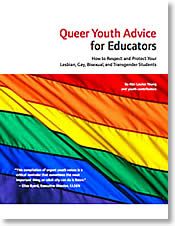
To continue the conversation, here is a link to an online booklet, Queer Youth Advice for Educators. You can read it online, print a PDF or order a hard copy. It is a collection of insights from LGBTQ youth about their educational experiences, and ways in which they felt supported or abandoned in the process. A compelling read.
Thursday, December 8, 2011
Jay Smooth on ways to discuss race and racism
This video has been featured recently on several websites, a testament to the thirst out there for helpful suggestions on how to address the topic of racial identity and racism. Jay Smooth, who produces a video blog, Ill Doctrine, is the speaker, and does an excellent job of presenting a shift in the way we can think about racism and microaggressions. He advocates moving away from the good person/ bad person dichotomy to considering racist acculturation as something akin to tooth plaque, something out there in the environment which accumulates and requires daily and intentional action to address and remove from our being. His presentation is a really nice way of minimizing the stereotype threat most self-identified white people feel that they will be perceived as bad racists, a minimizing which allows for the possibility of genuine insight and empathy to emerge from "race" discussions.
Saturday, December 3, 2011
An inspiring speech
An inspiring speech which Zach Wahls gave to the Iowa House Judiciary Committee on Jan 31, 2011 about being the son of a married female couple. Must have been such a proud moment for his parents.
Thursday, November 24, 2011
Reconsidering Thanksgiving
Dear Parents and Teachers
Thanksgiving is one of my favorite holidays. Like many of you perhaps, I love the combination of cooking, eating, Fall and family time.
But it’s also a great jumping off point, with our children, to challenge what we think about this holiday, and its history, from a new perspective. Thanksgiving is of course a bittersweet day, at best, for many of the indigenous people of North America for whom the day is a reminder of betrayal and loss.
I put together some resources; movies, books and other notes that may be interesting to consider over the holiday. I particularly enjoyed the PBS American Experience documentary series, entitled “We Shall Remain.” The first episode of the five part series is After the Mayflower. It tells what we now believe unfolded between the Pilgrims and the Wampanoag Indians. Through interviews with historians and re-enactments, this episode examines the Wampanoag's assistance to and alliance with the Pilgrims and the tragic events over the next 50 years. It’s quite a story. It is appropriate for general viewing but does contain some powerful descriptions and images which may be too much for very young viewers, for instance, a facsimile of a severed head. This occurs in the film after 1:09 minutes if you want to preview before deciding if appropriate for your whole family.
Here are some other resources I found thought provoking too:
Should I correct Thanksgiving stereotypes my kids see on TV?
Oyate: Recommended children's books about Thanksgiving
Teaching about Native American Issues
Have a very happy Thanksgiving.
Josie
Thursday, November 17, 2011
Parent/Guardian Diversity Education Series- Part One
Hello Parents, Guardians and Teachers,
We had a great session with Nathan Shara this week. Nathan, a facilitator with Seattle Safe Schools, led us through an exercise to examine how we develop protective shields to negotiate the world, which protect us against social identity vulnerability, but can interfere with our ability to see and communicate with others.
He started by drawing a heart which contained qualities of a newborn child. Participants offered qualities, such as "curious, trusting, capable of a range of emotions, unself-aware" etc. Around the heart we listed things which might be said to that child as he or she grows up, and considered how those messages varied if the child were light or dark skinned, able bodied or not, girl or boy etc. Messages proffered included, "you're sweet, exhausting, stupid, too sensitive, weak, a problem, ugly," etc. Nathan talked about how these messages are heart attacks, or attacks on the heart, and how in response, we develop shields to protect ourselves. Examples of shields were,"I won't care much about school work because everyone says I can't be intelligent," or " I'm going to numb out because I'm not allowed to be emotional." He then had us perform this exercise for ourselves, listing our heart qualities, the messages we have taken in and the shields we developed as a result. It was a moving exercise.
You may wonder what this type of introspective work has to do with social equity or learning how to help our children with gender identity development, the stated objective of the workshop. I think one of the aspects which makes social equity work so compelling, if challenging, is that it involves both political and personal transformation. Neither is enough, and indeed both journeys, the internal and the external, fuel each other. When I started this work, I wanted a ready made answer, a book or a role play guide, to teach me the skills of parenting my children through a social equity lens. But the books and the expert guidance are not enough, unless the transformation is also occurring within. The example we embody to our children and peers, as parents grappling with uncertainty and making ourselves vulnerable to learning and tenderness in our own hearts, is the basis for any political change we will be able to accomplish in our families, our school or the world.
Because of time constraints, we watched just a few minutes of It's Elementary. I am happy to announce a screening of the full length version of the film, with discussion after, on Thursday, December 15th, in the Community Room, from 8:45 until 10:45 am. Here is a link to the trailer for the film.
Josie
Subscribe to:
Posts (Atom)